


|
|
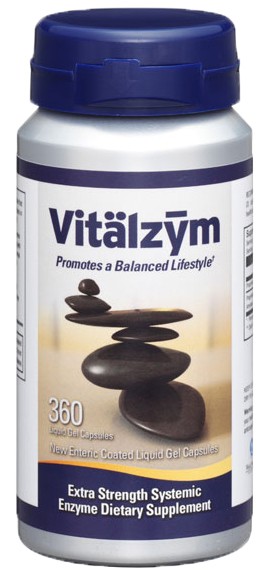 Proprietary blend contains: Bromelain, papain, rutin, amylase, protease, lipase,
amla and serrapeptase. For a full description of these ingredients, see below.
Proprietary blend contains: Bromelain, papain, rutin, amylase, protease, lipase,
amla and serrapeptase. For a full description of these ingredients, see below.
Other ingredients: Medium-chain triglycerides, starch, glycerin, polysaccharides, pH resistant enteric coating, beeswax, glycerin fatty acid ester, lecithin, citric acid.
For a full description of proprietary blend ingredients, see below.
Vitalzym Extra Strength is natural and 100% vegetarian. It contains no artificial flavors, artificial colors, yeast or gluten. Vitalzym Extra Strength is also lactose free and contains no harmful talc.
| Capsules per container | |||
| Serving size | Three (3) capsules |
Three (3) capsules |
Three (3) capsules |
| Servings per container | 120 |
60 |
20 |
| Amount per serving | 168 mg ** |
168 mg ** |
168 mg ** |
**Daily Value not established.
Suggested Use: As a dietary supplement, take 3 capsules daily, or as recommended by your healthcare professional. Take capsules at least 1/2 hour before a meal, 1 hour after a meal, or any time in-between meals. Or, take an activation dose as recommended by a healthcare professional. Read Vitalzym Suggested Use for further guidance.
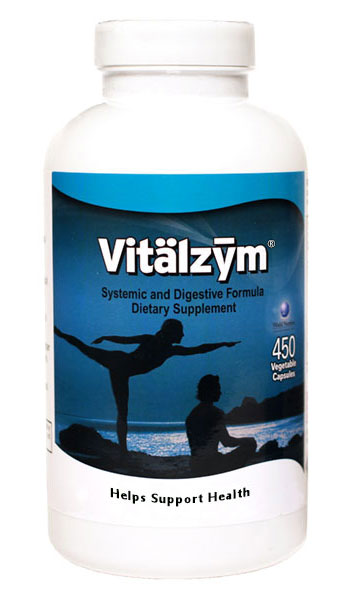 Proprietary blend contains: Protease, serrapeptase*, papain, bromelain, amylase, lipase, rutin and amla
Other ingredients: Rice Extract, Vegetarian Capsules (Cellulose, water).
For a full description of proprietary blend ingredients, see below.
Original Vitalzym is natural. It contains no animal derivatives, artificial flavors, artificial colors, yeast or gluten. Original Vitalzym is also lactose free and contains no harmful talc.
| Capsules per container | 450 |
| Serving size | Three (3) capsules |
| Servings per container | 150 |
| Amount per serving | 1,500 mg ** |
Suggested Use: As a dietary supplement, take 3 capsules, 1 to 3 times daily. Take capsules at least 1/2 hour before a meal, 1 hour after a meal, or any time in-between meals. Or, take an activation dose as recommended by a healthcare professional. Read Vitalzym Suggested Use for further guidance. Keep in mind that the suggested dosage of original Vitalzym is twice that of Vitalzym Extra Strength.
WARNING: DO NOT take a Vitalzym product without the consent of your physician if you are lactating or currently taking prescription anticoagulants (blood thinners). As always, you should consult with a health care professional and/or pharmacist if you are taking prescription medications and would like to include dietary supplements into your regimen.
Not everyone should take Serrapeptase. This includes:
During the detoxification process, medications that have been stored in the liver may cause one to experience side effects that are related to its use and would not be considered a side effect from Vitalzym.
Please talk with a health care professional if you feel you may be having symptoms that are unrelated to detoxing. Detoxification effects that can occur when taking Vitalzym products can include heart palpitations for some individuals. If this occurs, you can reduce your dose to minimize the cleansing response. If you do experience heart palpitations that you feel may be unrelated to detoxing, please consult with a health care professional.
Additionally, Vitalzym products can increase the effectiveness of certain medications; another reason to consult with a doctor or pharmacist prior to using them if taking prescription drugs.
Manufactured by World Nutrition, Inc. All Vitalzym products pass USP (United States Pharmacopeia) testing for disintegration and dissolution. USP is a publication established in 1820 that contains legally recognized standards of identity, strength, quality, purity, packaging, and labeling for drug substances, dosage forms, and other therapeutic products, including nutritionals and dietary supplements.
Also known as Indian gooseberry, Emblica officinalis is the richest source of Vitamin C. It also contains tannic acid, glucose, protein, cellulose and calcium. Amla is useful for stomach problems, it is antipyretic, hair tonic and nerve brain tonic. It's also useful in anemia, hyperacidity and in gynecological problems and epistaxis. Amla is considered to have restorative and preventive properties.
A digestive enzyme that breaks down carbohydrates and increases absorption of essential nutrients from food.
Both Bromelain and Papain are plant derived proteolytic enzymes. Bromelain, also known as bromelin, is a protein-digesting enzyme extracted from the flesh and stem of the pineapple plant, Ananas comosus. . Bromelain is most notable for its effectiveness in the reduction of inflammation and decreasing swelling, but the scope of its benefits continues to increase. As a natural enzyme that supports a healthy inflammation response, bromelain has many uses. It promotes bone and joint health as well as improves healthy circulation. The benefit of bromelain occurs over a broad range of doses, and even small amounts may be beneficial to improving cardiovascular health.
Papain, is a proteolytic enzyme isolated from the papaya plant, Carica papaya. Papain has been shown to be effective in promoting wound healing after burn and rejuvenating skin cell health.† Papain is also used for the following:
A digestive enzyme that breaks down fat during the digestive process and increases the absorption of nutrients from food.
The term "proteolytic" refers to all enzymes that digest protein. In the body, proteolytic digestive enzymes (including amylase and lipase) are produced in the pancreas, but supplemental forms of enzymes may come from fungal or bacterial sources, extraction from the pancreas of livestock animals (trypsin/chymotrypsin) or extraction from plants (such as papain from the papaya and Bromelain from pineapples). The primary uses of proteolytic enzymes in dietary supplements are used as digestive or systemic enzymes.
There are a number of clinical trials showing the benefits of using oral proteolytic enzymes as a digestive aid. Proteolytic enzymes are also believed to help improve allergy-related immunity, support joint and bone health, and maintain a healthy inflammation response.
Is one of the many existing flavonoids. Flavonoids are a class of water-soluble plant pigments. Flavonoids support health by strengthening capillaries and other connective tissue, and some function as support for a healthy inflammation response and immune health. Rutin and several other flavonoids may also improve blood vessel health.
Serrapeptase, also known as Serratiopeptidase, is a proteolytic enzyme isolated from the non-pathogenic enterobacteria Serratia E15. The enzyme is found naturally in the intestine of the silkworm, which is used by the silkworm to dissolve the cocoon and emerge as a moth. The enzymes are then cultured and extracted in a lab from the medium so that not a trace of fungus is left on the enzyme and the purity is assured. This enzyme is able to digest various tissues, yet will not eat away at tissue the body needs.
Unbelievable Health Benefits of Bromelain
Healing Power of Proteolytic Enzymes
NUTRITIONAL AND PERSONAL CARE PRODUCTS DISCLAIMER: Content on this site is for reference purposes and is not intended to substitute for advice given by a physician, pharmacist, or other licensed health-care professional. You should not use this information as self-diagnosis or for treating a health problem or disease. When you receive an item, carefully read all labels, warnings, and directions before use. Actual product packaging and materials may contain more and/or different information than shown on this website. Contact your health-care provider immediately if you suspect that you have a medical problem. Information and statements on this website regarding dietary supplements have not been evaluated by the Food and Drug Administration, and are not intended to diagnose, treat, cure, or prevent any disease or health condition. *Results May Vary. USE OF THIS SITE: By using this site, you signify your assent to our Terms and Conditions Agreement, Privacy and Security Policy Agreement, Shipping and Ordering Policy and International Shipping and Ordering Policy. Please read them all carefully. If you do not agree to the terms and conditions contained in these policies, you may not access or otherwise use this site. These Agreements apply to any transaction or relationship between the parties, including those related to the use of this website and/or the purchase and sale of merchandise through this website or from Energetic Nutrition, Inc. by other means, including email, telephone, or live chat communication, social media postings, and postings of reviews to the EnergeticNutrition.com website. |
|||||||

|

|
|

|
|

|
||